



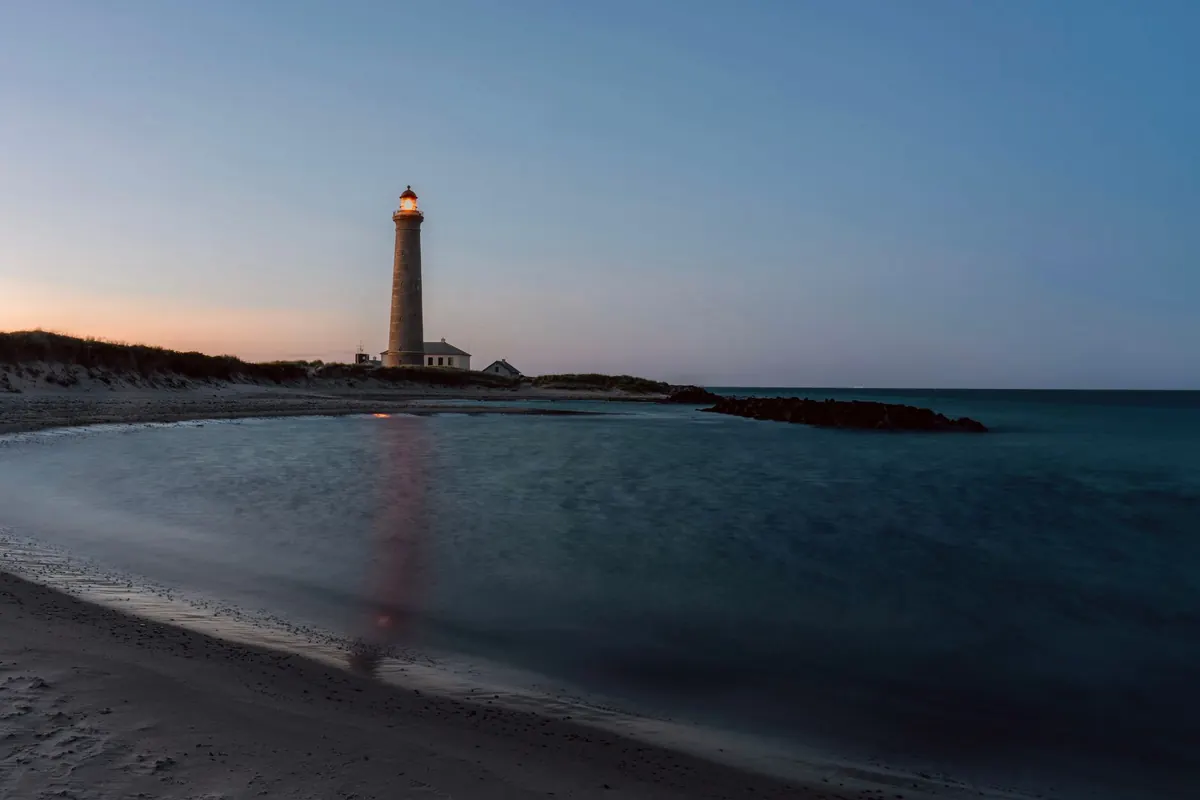
Stand on any harbour wall at dusk and the first light you see does one simple job: it tells you where the land stops. Put two such lights within a night's sail of each other and the simple job collapses. Which one is which? Is that a lighthouse or a fishing boat's lamp? Am I looking at a light two miles off or twelve? Those questions pushed coastal authorities to give every major light a signature — a rhythm, a colour, a period, a range — and to keep refining it for two centuries. The patterns are not decoration. They are a language, and they still repay reading.
Fixed Lights and the Problem of Being Unmistakable
Early coastal lights were mostly fires: coal, wood, sometimes oil in an iron basket on a tower top. They served as landfalls and they failed as identities. A fixed flame could be a lighthouse, a farmer's bonfire, a lit window in a manor house, or another vessel's lantern. On a dark coast with a lee shore, that ambiguity cost ships.
The first fixes were about height and brightness — taller towers, better fuel, then parabolic reflectors that gathered the flame into a beam. All of it made a light visible further away. None of it told a mariner which light he was looking at. A fixed light also says little about distance: one on a low point and one on a cliff look much alike from a mile off.
Why the Light Started to Blink
Rotation solved both problems at once. Mount a lamp and reflector — later a lens — on a turning frame and the beam sweeps the horizon like a searchlight. An observer sees a flash as it passes, then darkness, then another flash. The interval is set by the machinery, so it becomes a fingerprint.
The second benefit was optical. A rotating apparatus concentrates the same flame into a narrow pencil of light instead of spilling it around the horizon. Same fuel, far greater reach. Flashing was an identifier and an economy in one.
Not every light needed to turn. An occulting screen — a shutter, often clockwork-driven — could pass in front of a fixed lamp at intervals, producing a steady light broken by short eclipses. That left two families of character: light that is mostly on, and light that is mostly off. The difference matters when you are counting seconds on a rolling deck.
The Grammar: How Light Characters Are Named
Hydrographic offices settled on a small vocabulary. Once you know it, a chart abbreviation reads like a sentence.
- F (fixed): continuous, unblinking light.
- Fl (flashing): a flash with the dark interval longer than the light. A number in brackets gives a group — Fl(3) is three flashes, a pause, then three again.
- Oc (occulting): a steady light interrupted by short eclipses; the light period is longer than the dark.
- Iso (isophase): equal light and dark, easy to time by ear or watch.
- Q and VQ (quick, very quick): rapid flashes, mostly on buoys rather than lighthouses.
- Mo(A): a Morse letter flashed in code.
- Al (alternating): the colour changes with the rhythm, for example white then red.
Colour adds a second layer. White travels furthest; red is used for warning sectors and for marks where a brief loss of light matters less than knowing you are in the wrong place. Sectors are cut into the optic so a red beam covers a shoal and a white beam covers the fairway. Seeing red where you expected white is a message, not a fault.
Range, and the Three Numbers Behind One Word
"Range" on a chart is not one thing, which is why the figure confuses people.
- Nominal range: the charted figure, defined for a meteorological visibility of about 10 nautical miles. It describes the lamp and lens, not the weather.
- Luminous range: what the light actually reaches in tonight's visibility. Fog can cut a 20-mile light to two; exceptional clarity can stretch it.
- Geographic range: the limit set by the curve of the earth and the heights involved — roughly 2.08 × (the square root of the light's height in metres plus the square root of your eye height in metres), in nautical miles. A tall light seen from a low deck can sink below the horizon long before its nominal range runs out.
The smallest of those numbers governs. And when a light sits just below the horizon you may still see its loom: a pale glow in the sky above the lamp. It tells you the light is there without giving a bearing you can trust.
Reading a Chart: A Worked Example
Here is a typical chart entry for a lighthouse:
Fl(3) WR 10s 24m 18M
Read it left to right. Three flashes in a group. White and red, so there are colour sectors. A period of 10 seconds from the start of one group to the start of the next. A focal plane 24 metres above high water. A nominal range of 18 nautical miles in clear weather. The chart will also describe the structure — "white round tower, red band" — because in daylight the paint job is the identifier.
- Time the period with a watch or a steady count, starting at the first flash of a group.
- Count the flashes, then note the colour of each.
- Compare with the chart. Rhythm right but colour wrong? Check your sector.
- Neither right? Suspect your position before you suspect the light.
Leading lights use character to hold you in a channel: a front light and a rear light kept in line, often given different rhythms so the two are never confused. Aligned, you are on the axis; separated, you are off it.
What Automation Changed, and What It Left Alone
The classic era rested on Fresnel lenses — concentric rings of glass that bent a flame into a beam — and on clockwork, weights and floats that turned the optic at a measured speed. First-order lenses were room-sized; sixth-order ones fitted a harbour. Acetylene with a sun valve let a light switch itself on at dusk, and electricity, then LEDs and solar panels, finished the job. By the end of the twentieth century most authorities had automated and withdrawn keepers.
Satellite positioning and electronic charts changed the balance of navigation but did not make the pattern obsolete. A charted rhythm is a free independent check that works when a screen does not. And a character, once published, is hard to alter: it lives in chart editions, light lists and sailors' memory, so any change goes out as a notice to mariners first.
Practical Notes for Reading a Light
Whether you are on watch or on a cliff path, a few habits make the patterns useful:
- Look it up before you need it: character, period, sectors and range for every light on your track.
- Time a full period, not a single flash. Groups and pauses are where confusion starts.
- Never identify a light by colour alone; pair colour with rhythm and a bearing.
- Assume fog. Know the fog signal, if any, and treat range as a fair-weather promise.
- Keep the light list current. Characters do change, and an old chart sends you hunting a rhythm that no longer exists.
From the shore the pleasure is simpler: find a character you can see and count it. Two seconds of light, four of dark, a ten-second period — the same rhythm a master once used to fix a position on a black night. The lens is electric now and the keeper has gone home, but the sentence the light spells out is unchanged.